Vietnam

Sunday, May 13, 2018

Utah May 2018

Looking for adventure and beautiful scenery southern Utah is a great choice. The temperature can become extremely hot in this state so choose the time you want to visit with what you want to do. We were interested in hiking and there are lots of opportunities. You can choose National Parks, State Parks, and the National Forest Areas. The elevation was high so it is important to make sure you are careful about how fast you are walking and don't forget that you are in a desert area so you will need plenty of water. For more information on the parks in the area check out this link Parks in Utah
Backside of Mountain at Brian Head

We stayed at Brian Head which is a ski resort area in the winter and the chairlift operates in the summer for a trip to the top of the mountain. The elevation is around 10000 ft so it was cool and you could still see snow drifts in the area in May. The summer activities on the ski hill were not open yet so the area was very quiet. From this location, we could visit Zion and Bryce Canyon National Parks easily. These parks are extremely busy and you need to plan accordingly. 

Zion National Park has thousands of visitors each year so they have restricted access to the park. You need to take a shuttle bus into the valley.  The bus can be caught at the visitor's centre. The queue to catch the bus can long so arrive early to get a parking stall and avoid the lineups for the bus. Don't park outside of the designated parking stalls or you will be towed and the current rate was $300 US to get your vehicle back. If the lot is full at the Zion visitors centre there might be parking along the road within the park. We chose to drive the road through the park and to return earlier the next day to get good parking. Parking in town costs $20.00 US but they do provide a free shuttle to the park where you can transfer to the National Park shuttle. If you are planning to visit three national parks within a year it is worth purchasing an Annual Park Pass which was $80.00 US.


Overlook of the valley road going up to the tunnel.
 Trail to Overlook
The drive you can do within the park is spectacular. It is very twisty with lots of switchbacks as you climb the mountain towards the tunnel. The road is very congested so be prepared to take your time an the views are spectacular.  The tunnel its self is an engineering feat when it was built. If you are driving a motorhome you will need to pay extra at the Visitors Centre to drive through the tunnel because they have to stop the traffic and make it one way to accommodate the height of a bus or motorhome. On the east side of the tunnel is a great hike to a viewpoint that overlooks the valley that you just drove up. After the tunnel, there are numerous pull-offs so you can stop and hike or just admire the scenery which is different from the valley below. You can continue on this road to Bryce Canyon if you wish. We decided to visit Pink Coral Sands State Park for a picnic before return to Zion in the late afternoon when the park would be less busy.


Pink Coral Sands State Park will cost a small fee to enter. The sand has been created by the break down of the pink granite in the Escalante and the wind blowing the sand into the valley. The tallest sand dune in the park is 100 ft high. The park allows ATVs on the dunes and there is an interesting interpretive trail talking about the sand dunes and native plants. 


s
Quiet Oasis
Returning to Zion National Park after 6 pm was a quieter experience that at 10 am. Most people have left the area so to drive through the tunnel there was less of a wait and no queue for the shuttle into the restricted area. We decided to do a short hike into a waterfall and enjoy the park before returning the next morning earlier.


Because the trial had fewer people in the evening we encountered2 wildlife.

Surprise Visitor
The next day we arrived at the visitor's centre before it opened but the parking lot was already filling up. There was a short lineup for the shuttle but we did not have to wait long. This time we were riding the shuttle all the way to the end of the valley where the narrows trail starts. Because we had stopped at the visitor's centre the day before we had already planned our hikes for the day.

walking path to the narrows

At end of the shuttle road, we jumped off to start the walk up the valley to where the stream crosses the trail. This short hike is very popular and is the start of the trail that follows the river up to the narrows. You need to watch the weather when near the river at the end as flash floods can be a problem when it rains. The water temperature was 50 F so wading across the river multiple times was not very exciting but there were lots of people with special hiking boots and walking sticks doing the full trail.
Hanging Gardens

On the walk up to the river, you pass several rock walls that have hanging gardens. The plants have found small crevices and cracks in the rock face to grow from and there is dripping water that helps to keep them alive.  


Survival in the rock face
Start of the Narrows

This is the end of the easy hike up the valley. From this point on you have to cross the river numerous times to reach the slot canyon. If you look closely at the picture you can see numerous groups of people walking up towards the end of the river.


Along the trail, there were lots of squirrels.


Wednesday, February 21, 2018

Arenal Volcano Area in Northwest Costa Rica


The day after flying into the domestic airport in San Jose we drove up to La Fortuna to visit the area around Arenal Volcano. From San Jose, we took the number 1 highway to San Ramon then turned north toward La Fortuna. The highway is an excellent two lane road with frequent passing lanes. The biggest drawback is the volume of traffic. Make sure that you leave lots of time so that the frequent traffic jams don't increase your stress.

Coti eating an Iguana
Once through the town of San Ramon, the road narrows and follows the contour of the mountains. This road is very twisty and windy. The area is mainly agricultural with little towns along the way.  Watch out for the 25 Km school zones in each town. The road usually has two toupees (speed bumps) in these areas and your vehicle will take flight if you don't slow down. You also need to watch out for the narrow bridges. One lane usually had a ceda (yield sign). Signage along the road is good as long as you know which town is next. Even if you do not know Spanish it is easy to figure out what the road signs mean. The most interesting sign I saw do not feed the Coti!


One interesting stop along the road is the suspension bridge over a deep canyon. On the north end of the bridge is a nice restaurant and a small deck at the river's edge to view the canyon and bridge. You might see some interesting birds at the feeders on the platform as the put fruit out for the birds. This is a great rest spot.


There is a fairly long stretch of road where there is not a lot of development. The whole trip from San Jose airport to our hotel just outside of La Fortuna took us about three hours to drive in good weather. 

When we did the drive back to San Jose to catch our flight out the weather was rainy and the clouds in places were so low that you could not see very far in front of the car. Headlights were definitely needed! 

La Fortuna is a small town with a gas station on the one-way street travelling west through the centre of town. The town has a variety of tourist services available from restaurants, tour offices, souvenir shops and accommodation. There is also an airport just outside of town if you do not wish to drive, hire tourist transportation or take the bus.

View of Canyon and Volcano 
Outside of town towards Arenal Volcano are some high-end resorts and a variety of activities. Our accommodation was the Nayara Hotel and Spa a Costa Rican hotel. This is a beautiful property consisting of two different hotels that you could use the services at both hotels. Between the two proprieties is a canyon that has been preserved for wildlife. Because of the reserves within the property and the things they do to preserve the environment the resort is considered ecotourism. There are several pools in the resorts and some are identified for adults only. You can also book a variety of tours from the hotel and they also specialize in private tours.


Our first full day we drove up to Arenal National Park and hiked to the 1998 lava flow. There is a second area you can visit for the entry fee that allows you to walk down to the lake. The lake is man-made when the dam was built and provides fresh water and electricity for the area.


The town of El Castillo is very small and to reach this area you need to travel a bumpy gravel road. This town has accommodation, zip lining, river rafting, hiking, a butterfly sanctuary and reptile display. We visited the Butterfly Conservatory and this was very informative. The owner is an expat from the US and has studied and cultivated butterflies for years. If you are thinking that you want to visit make sure you have enough cash credit cards are not accepted. They also accept volunteers from around the world to work at the place. We met a man from Denmark during our visit. www.butterflyconservatory.org 

Day two we woke up to a perfectly wonderful cloudless view of Arenal Volcano. We could see the top smoking and I quickly grabbed my camera and went in search of the perfect picture. The Volcano is frequently in the clouds but we were very fortunate to see it so clearly. By the afternoon the clouds were back and it started to rain. One of our guides told us that it rains 400 days a year in this area even in the dry season.

We did a nature tour at the resort and Bill was excited to see a three-toed sloth. We spent the afternoon driving the north edge of the lake. There is not a lot along this area and it was difficult to stop and see the lake. A lot of the property in this area is private or tourist accommodation. Some people were taking a pontoon boat out on the lake but it was so rainy we choose not to do this.A

On Hanging Bridge
Motmot Bird
Our fourth day started at 5 am. We had booked a birding tour with Mystic Hanging Bridges www.misticopark.com and had to be there by 6:10 am. The night before was a steady rain but it had stopped. When we arrived at check in it started to rain again so we had a coffee and granola bar hoping the rain would lighten up which it did. The tour was small and we had a wonderful guide named Indira. We saw several hummingbirds, a variety of birds, learned about the local vegetation and watched the squirrel monkeys search for food.

When we returned to the hotel we had a great breakfast and then spent time resting before going the Eco Termales at 4 pm. The hot pools here are very different from Canadian hot springs. The water was very clear and no sulphur small. There were multiple pools to soak in.  We started in the coolest and moved towards the warmer pools. One pool had black sand on the bottom and the pools were built with cement and round rocks. The only allow 80 people into the pools during each five hour period of time. You can also choose to eat at the buffet or a la carte restaurant. Your bracelet has a barcode so you can order all your drinks and food using your bracelet and then they collect when you leave. For more information, you can visit their website at www.ecotermalesfortuna.cr  

Monday, February 12, 2018

Aguila de Osa Lodge in the Southern Zone


Relaxing Get Away

We enjoyed the heat, peacefulness, and extreme beauty of the incredible rainforest on the Osa Peninsula in southwestern Costa Rica. Getting to the lodge is an experience in its self.

We flew Sansa Air on a one propellor plan from the domestic airport near San Jose International Airport to Palmar Sur about a 30-minute flight. From the airport in Palmar Sur, a tourist taxi picked us up and drove the 20 minutes to the town of  Seripe. From the boat dock in Seripe, we took a motorboat for a 45-minute ride down the river and out onto the Pacific ocean. The ride was excellent and very exciting as the boat maneuvered through the ocean waves meeting the river. At times the waves can be 5 or 6 feet high. We had wanted to fly direct to Drakes Bay but the airport was closed as the government was making the runway safer.

The lodge is situated on a hill so be prepared to climb steps and get your Stairmaster exercise a few times a day. But the climb is worth it as the view over Drakes Bay is fantastic and the bird life is fascinating from Toucans to hummingbirds.

There is always lots of opportunities to keep busy while staying at the lodge through the numerous tours they offer.

We had a fascinating tour of the Terraba-Sierpe Mangroves, the largest untouched mangrove forest on the Pacific Coast of Central America. The wildlife viewing was spectacular! A hidden world, accessible only by boat and home to over 1000 birds, including the endemic Mangrove Hummingbird found nowhere else on the planet, the ecosystem is absolute paradise.


On our trip, we saw American crocodiles,  rare birds, the mangrove tree boa, iguanas, Jesus-christ lizards (that walk on water), river turtles, howler monkeys, spider monkeys, and the vicious white-faced capuchin monkeys . . . and then it happened . . . we looked to our right and there was the ant-eater sleeping in a tree.


Another day we decided to hike the trail to San Josecito beach from  Aguila de Osa Lodge. We were told the walk would take about two hours but with frequent stops to view the birds, wildlife and to cross a river it actually took three hours. During our walk we were confronted by a band of wild Capuchin monkeys - Elaine was hit on the head by one monkey with a huge stick and another shook a tree sapling at Bill, however, he stood his ground and we got a great video.


We took an excellent snorkelling tour to Cano Island.  Cano Island is a Biological Reserve and we had great visibility. There were schools of jackfish, lots of puffer fish, and a large variety of other tropical fish. Going out to the island we had an opportunity to see dolphins.


We hiked for over three hours along a path that leads into Cordova National Park as all our tours were completed.  We had an encounter with Capachino Monkeys as we wandered aimlessly down the path we had to ford a river.

Lying on the beach we saw flying fish skirting out of the water, dolphins and a humpback breached close to shore.


right in front of us. . . . after watching the leaf-cutter ants cross our path we continued on our way to the beach to meet the boat from Aguila de Osa that takes tourists snorkeling on Canso Isalnd.  No use walking back to the lodge over humongous trees, snake infested bushes, scary rivers, and scortching heat.

People at our lodge caught many fish i.e., 45 lb Marlin, snapper, grouper and lots of sail fish - great place to fish in Costa Rica

Looks like Nature Air is going under so we will have to rely on Travel Guard Canada to bail us out of the $685 USD owed to us . . . lots of stranded tourists on the islands off of Drake Bay - - - sitting ducks for the big cats, snakes, sharks, monkeys, and a horde of other night time predators

It was well over 90 degress everyday down in Drakes Bay so we are looking forward to cooler weather, hot springs, at Arenal (higher elevation) . . . as we drive up the bumpy lava roads


Friday, January 26, 2018

San Jose Costa Rica

San Jose is a large city located in a valley between several volcanic mountain ranges. In January and February, the valley has very strong winds that blow. This can affect airline travel as our non-stop flight was to stop in Liberia, Costa Rica when we departed from San Jose to take on fuel.

San Jose is the capital of Costa Rica and so has similar problems to any large city. We did not have any issues walking around and we stayed right downtown on the pedestrian street. The Presidente Hotel is a modern Costa Rican Hotel. With a great breakfast buffet that included eggs or omelet prepared the way you want. 

We visited the National Museum and learned about the history of Costa Rica. The museum is housed in an old fort. When you initially walk into a butterfly garden before actually seeing the historical displays. It is always an interesting experience to have a variety of butterflies hovering around.

The museum explains the challenges that Costa Rica endured before developing an export economy through the sale of coffee. Costa Rica does not have a military and they do not allow hunting of animals. Their goal is to be the first carbon-neutral country by 2023. To help achieve this goal there are large areas that support natural environments.

Between the National and Jade museums, you can find an artisan market. The market is set up with small stalls and narrow walkways. You can find a variety of tourist items from wood items, mounted butterflies to hammocks as well as shoes, backpacks etc. Remember to bargain and if on stall has an item you like the next stall will probably have the same item. 

The Jade Museum is expensive for foreigners. The museum houses a variety of artifacts from pottery to jade jewellery. The displays are modern with lots of opportunities for hands-on experiences and they use a lot of technology to help explain the displays. If you are interested in seeing the selection of jade make sure to open up the display case on the top floor. It is a good idea to take the elevator to the top floor and work your way down to the main floor.
The opposite west of the Museums and just off the pedestrian walkway by the modern square you will find the National Theatre of Costa Rica (Opera House). We took a tour of the Opera House. This structure is very similar to the Opera house in Buenos Aires, Argentina. The main floor can be raised and the seating removed to create a dance floor or dining area. There is a lot of history and architecture detail in the National Opera House. On the second floor is a ballroom and the countries Presidents private box.

If you are interested in shopping take a stroll down the promenade. This is always a great way to see what a city is like. You will find a variety of small shops with everything that a family needs.

We stayed at the Hotel Presidente on the pedestrian street. This hotel was recommended by a friend and was centrally located. The hotel has free parking for their guests. Breakfast was included in our room rate and was excellent. You could have traditional Costa Rican breakfast or they would cook you an omelette or eggs. Staff were very friendly and helpful. They will also recommend restaurants. We had an excellent meal at Tin Jo Asian Resturant near our hotel.

 No automatic alt text available.
Want a great view of the city head towards the district of Escazu (suburb) of San Jose. We had the opportunity to visit Mirado Tiquicia night view of the city was fantastic. The night we went dinner featured a Costa Rican buffet that you could watch them cook and was served right from the pan. There is also an a la carte menu. The cultural dance performance was an added highlight.


From San Jose, we rented a car and drove along highway 2 towards the south to see the Quetzal bird.  To read more check out the Central Highlands blog.


Central Highland of San Jose

The Journey to see the Quetzal Bird

The road becomes challenging to drive as you travel up the mountain south of San Jose but it is still passable. We had a reservation at Trogon Lodge near San Germaine. There are numerous lodges, cabins and hotels to stay at in this area. This is not as commercialized as Monteverde and is a cloud forest in the area. Recently with the heavy rains portions of the road have had landslides so you need to be careful when driving. The areas of concern are well marked and some repairs had been made.


The National Parque is located on the main highway before the turn toward Trogon Lodge.


The lodge was an excellent choice. We had a quiet room up the hill with a wonderful balcony that allowed us to watch the hummingbirds feed on the bushes near our room. The central highlands are cool at night in February and the temperature did get down to 4C. There were gas heaters that the staff light in the rooms each night and we were provided with hot water bottles nightly to warn our bed. The meals were good as served buffet style, they even catered to my lactose
intolerance. We eat breakfast and dinner each day at the lodge.

Hummingbird feeding on the flowering bush.

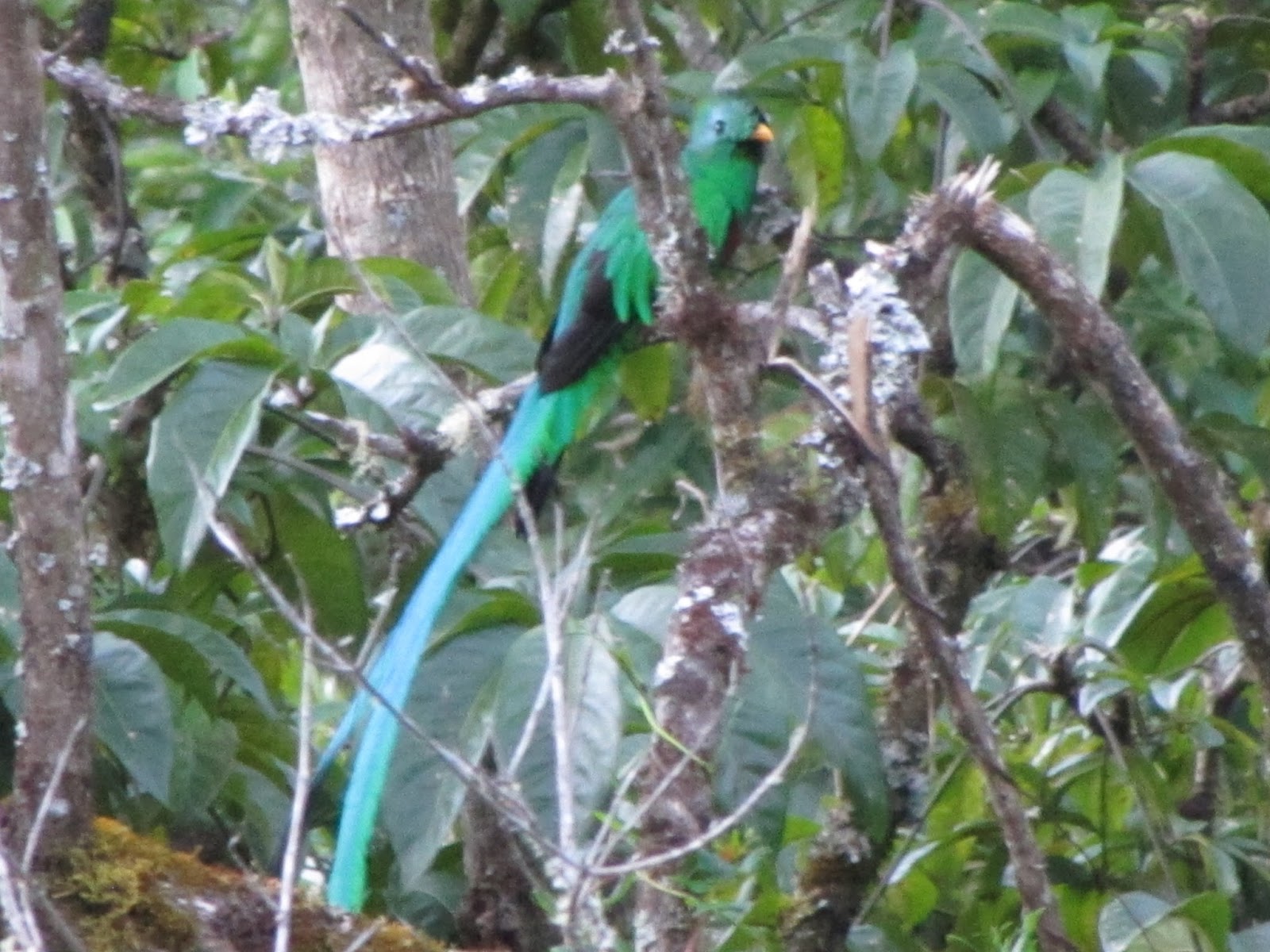
Male Resplendent Quetzal Bird


Since we came to this area to see the Quetzal bird we were up at 5:30 am to start our adventure. First a quick coffee and then we were off in the dark.  What we ended up doing was drivings along the road back towards the main highway. Everyone stops on the road and walks around looking for the elusive bird. The morning we went there must have been between 30 and 40 people all looking for the male Quetzal to see the beautiful long tail.


We found lots to do in the area. We hiked to the waterfall on the lodge property and did all the trails. Farther down the road is a nice area to hike to another waterfall and bird watch.


When we drove out toward the main highway again we stopped at Maria's Cafe. There is a bird feeder around back that attracts a variety of colourful birds.

The biggest challenge driving into the lodge was the road going from the highway to the lodge is narrow and extremely steep in a few areas. Be sure to gear down. If you are not comfortable with the drive you can always arrange a driver.

If you continue south on the number 2 highway to Palmar Sur and get to  Drakes Bay and then continue on highway 34 to San Antonia where you can visit Manuel Antonia National Park. Give yourself enough time to visit each area before returning to San Jose and on to your next destination. 


Wednesday, January 24, 2018

Costa Rica Awaits!


Costa Rica A Meca of Experiences

This is our third trip to Costa Rica. The first was a stop in Limon on the Caribbean side from a cruise ship.

The second trip was a visit to the area of Puntarenas and Manual Antonia National Park on the central Pacific the side of Costa Rica. This was our first birding experience in the country and we saw huge crocodiles in the Tarcoles River.  Quepos is an interesting town to base a stay in this area.

This time was our longest stay. We visited three lodges, spent time in San Jose, and went to Arenial in Alajuelato enjoy the hiking and hot pools. 

San Jose is a large city but there are several museums that we were interested in visiting. We chose to stay at Hotel Presidente right downtown so we would not have to drive to the museums. As with any large city you need to take precautions but we felt safe during our visit.

In the San Jose area, we travelled south of the city to the upper highland for our stay at Trogon Lodge. This lodge is located in the mountains and is close to the national reserve for the Quiszell bird.

Our next lodge was located in the Southern Zone near Drakes Bay. We took a flight from the Juan Santamaria Airport. Aguila De Osa lodge is located in an area that can not be accessed by car and was an interesting area to visit. We were able to take several tours from the lodge during our stay.

Our last stop was in northwestern Costa Rica near the Arenial Volcano in the Alajuuelato area. This was our luxury stay at the Nayara Hotel. We spent time hiking, relaxing and visiting the hot spring pools.

What an awesome time in Costa Rica and would recommend a visit to this country to everyone interested in more than just a beach holiday. If you also want the beach there are resorts near Liberia. You can fly to Liberia and can avoid San Jose completely.

Tuesday, November 7, 2017

South Baja California - Mexico

The Baja California peninsula is a beautiful area to travel. It is very safe part of Mexico and is frequented by Americans and Canadians. On the east side is the Sea of Cortez which was named the aquarium of the sea by Jacques Cousteau. The west side is the Pacific Ocean.

You can easily fly to the Sourthern Baja from Canada and land at San Jose del Cabo or Loreto. Cars can be rented from both airports and dropped off at the other airport. We rented from FOX rental car and decided to purchase the Mexican Insurance so we would have no problems when it was time to leave. It is important to purchase Mexican insurance even if you think you are covered on your own policy.  Don't purchase insurance online before arriving as you may not be covered. We have heard stories that people are not allowed to leave Mexico if they have an accident until it is solved or the vehicles are repaired when you don't have local insurance.

When traveling in Mexico you will be constantly approached about going to a time share presentation. Be aware that you get nothing for free without giving up your time and a very successful marketing presentation. Buyer Beware!

There are a variety of accommodations available in Cabo San Lucas and Jan Jose del Cabo. You can choose all inclusive, partial inclusive and hotels or hostels without meals. Bus transportation is available but remember that the drivers speak Spanish.


Driving from Cabo to La Paz the capital of Baja Sur is an easy drive. Part of the road is a divided highway the remaining is two lanes without shoulders. When we drove there was very little traffic and took about two and a half hours. There are mountains on the left called the Sierra de la Laguna.

We choose to stay downtown at the HBlue Hotel. The hotel is located downtown which allows you to easily walk to restaurants and the Malacon. The top of the hotel has a pool and a lounge area. This is a great spot to watch the sunset. La Paz faces west which provides for beautiful sunsets along the east side of Baja California.

We went to La Paz to have the opportunity to snorkel with the Whale Sharks. We choose to go with VIP Tours as their reviews are excellent.

We had an excellent trip and the opportunity to snorkel with the sea lion pups.

Snorkel Trip


From La Paz we continued to drive north on Highway 1 to Loreto. The highway after La Paz changes to a two lane road with no shoulders. Traffic drives fast on the highway and there were no police the whole trip. When you enter a town watch out for the toupees or bumps in the road to slow the traffic. The drive is easy and  will take about three and half hours. The desert was beautiful to drive through as the rainy season had just ended and the plants were still green. You pass through the Sierra de la Giganta Mountains.